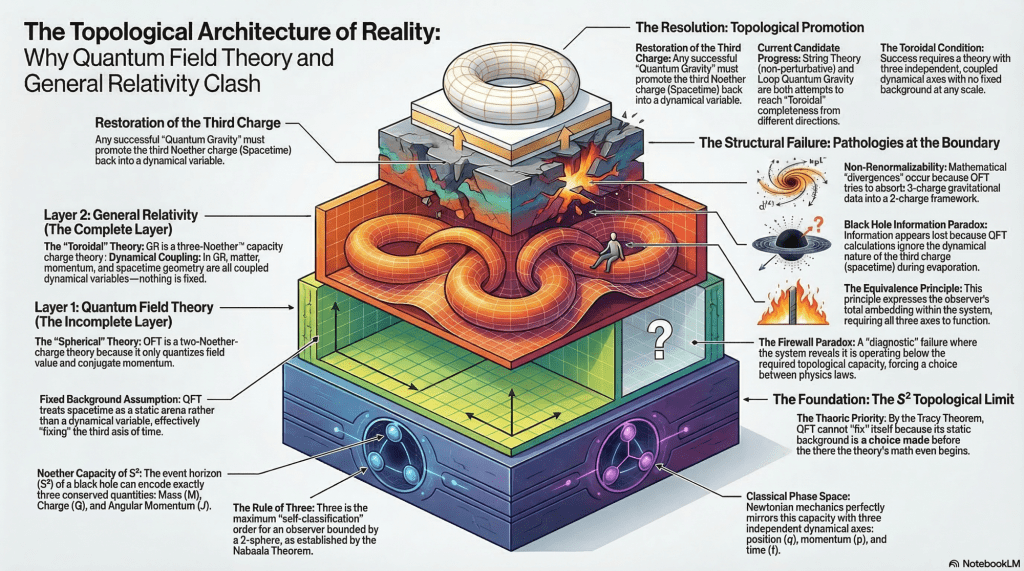
The problem of quantum gravity is usually described as technical. Quantum field theory’s equations blow up at small scales. The math produces infinities that no known procedure can clean up. We need, the story goes, a clever new technique — string theory, loop quantum gravity, something else — that tames the divergences and finally unifies our two best theories of nature.
That story is incomplete. The problem is not technical. It is topological. And once you see it, you cannot unsee it.
Start with a black hole. A black hole is one of the most extreme objects in nature. Anything that falls in — a star, a planet, a library, a person — is gone. All the complexity, all the information, all the history: gone. But not everything is lost. Three things survive, no matter what fell in: the total mass, the total electric charge, and the total angular momentum. That is it. Three numbers completely describe any black hole in the universe. This is the no-hair theorem, and it has been established rigorously.
Why three? This is the question that unlocks everything.
The answer is not arbitrary. The event horizon of a black hole — the boundary of no return — is topologically a sphere. A sphere has a specific symmetry structure: it admits exactly three independent continuous symmetries in the relevant physical setting. Time translation. Axial rotation. Electromagnetic gauge transformation. By Noether’s theorem — one of the most important results in all of physics — each continuous symmetry produces exactly one conserved quantity. Three symmetries. Three conserved quantities. Three numbers. The sphere cannot hold more. This is its topological capacity. The gate preserves only what the topology of its boundary can encode.
Now look at classical mechanics. Newton’s mechanics describes the motion of any physical system using three independent axes: position, momentum, and time. Not two. Not four. Three. The Principle of Stationary Action — the variational principle that selects the physically realized trajectory from all possible paths — operates on this complete three-axis space. Why three again? Same reason. The symmetry group of classical mechanics has exactly three relevant continuous symmetries: spatial translation produces conservation of momentum, rotational symmetry produces conservation of angular momentum, and time translation produces conservation of energy. Three Noether charges. Three axes. The classical phase space saturates the topological capacity of the sphere. The black hole and classical mechanics are saying the same thing. Three is not a coincidence. Three is the topological capacity of the spherical boundary of an embedded observer.
Now look at quantum field theory. Quantum field theory is our most precise description of the subatomic world. It has been tested to extraordinary accuracy. It is, within its domain, the most successful physical theory ever constructed. But look at what it quantizes. It promotes two quantities to dynamical variables — the field value and its conjugate momentum — and treats spacetime itself as a fixed background. The metric of spacetime is not a dynamical participant in QFT. It is a stage, set in advance, on which the quantum fields perform. Two dynamical axes. Not three. The third axis of the classical phase space — dynamical time, dynamical spacetime — has been fixed as a prior assumption before the theory begins. QFT inherited it from its construction. It cannot see it from within itself. It cannot correct it. It is, in a precise sense, a commitment made before the theory started, embedded in the theory’s foundations, invisible to the theory’s own tools.
Now look at general relativity. Einstein’s general relativity is our best description of gravity and spacetime at large scales. It treats spacetime not as a fixed background but as a dynamical participant: matter tells spacetime how to curve, and spacetime tells matter how to move. The metric is not given in advance. It evolves. It responds. It is a genuine dynamical variable. Three dynamical axes. All coupled. No fixed background. GR saturates the topological capacity of the sphere. QFT uses one fewer axis than the sphere requires.
The incompatibility is not technical. It is this. QFT is one charge short. When you try to merge a two-charge theory with a three-charge theory by adding perturbative corrections, you are attempting to introduce a new independent dynamical axis from within a framework that fixed that axis as a prior assumption. But you cannot derive the assumption from within the system that was built on it. The assumption is prior to the system. It is invisible to the system’s own tools. This is why perturbative quantum gravity fails. The divergences that appear at every loop order are not a technical nuisance awaiting a clever regularization scheme. They are the missing third charge asserting itself at the boundary of QFT’s foundational assumption. The theory has no machinery to accommodate dynamical spacetime because it committed to fixed spacetime before it began.
The known paradoxes are the same diagnosis. The black hole information paradox — does information fall into a black hole and disappear, violating quantum mechanics? — arises because Hawking’s original calculation treats the black hole background as fixed. It is a two-charge calculation applied to a three-charge situation. The information is carried by the dynamical third charge that the calculation excludes by assumption. The paradox is not a paradox in a complete three-charge theory. It is a symptom of the missing axis. The firewall paradox — the apparent contradiction between unitarity, the equivalence principle, and effective field theory at the black hole horizon — forces a choice between three physical requirements that a complete three-charge theory would satisfy simultaneously. The impossibility of satisfying all three within QFT is the signature of a two-charge framework encountering a three-charge reality.
Any successful theory of quantum gravity must treat all three Noether charges as dynamical variables. No fixed background at any scale. The third axis — dynamical spacetime, dynamical topology — must be a genuine participant in the dynamics, not a prior assumption. This is a necessary condition. It does not specify which theory will succeed. It specifies the topological category within which the successful theory must live. Perturbative approaches are ruled out immediately: they reintroduce a fixed background at the level of the background metric and are therefore still operating with two charges. Non-perturbative approaches — string theory’s non-perturbative formulations, loop quantum gravity, others — are attempting, each in their own way, to restore the third charge. Their difficulties arise precisely where they slip back into fixed-background assumptions. The search is not for a new equation. It is for a theory that treats spacetime topology itself — not the metric, not the connection, but the topology — as the fundamental dynamical variable. Such a theory would naturally have three dynamical charges. It would resolve the information paradox by restoring the dynamic boundary. It would not permit the pathological decompositions that signal topological incompleteness. And it would contain both QFT and GR as limits: the spherical approximation recovered when spacetime curvature is negligible, the full three-charge dynamics restored when it is not.
This diagnosis follows from a series of results developed across a broader framework — the Imagination Machine series — that connects the topological constraints on embedded epistemic systems to physics, mathematics, political theory, and the foundations of formal systems. The connection between the black hole’s three conserved quantities, the classical phase space’s three axes, and the minimum condition for stable self-correcting systems turns out to be the same result at different scales. Three is the topological capacity of the spherical boundary. Physics at every scale is organized by this capacity. The incompatibility of QFT and GR is what happens when one theory honors it and another discards one of its charges.
The black hole knew. It was trying to tell us all along.
The full mathematical treatment is developed below!
 The Imagination Machine